
 Home
Home ByKus Academy
 History
 Philosophy
 Anthropology
 Mythology
 Theology
 News
News World
World Economy & Finance
 Health & Lifestyle
 Science & Tech
 Culture
 Cinemania
 Bookshelf
 Who is?
 What is?
 Art
Art Türkçe

More Than Just Myths: Love, Lies, and Power Plays on Mount Olympus
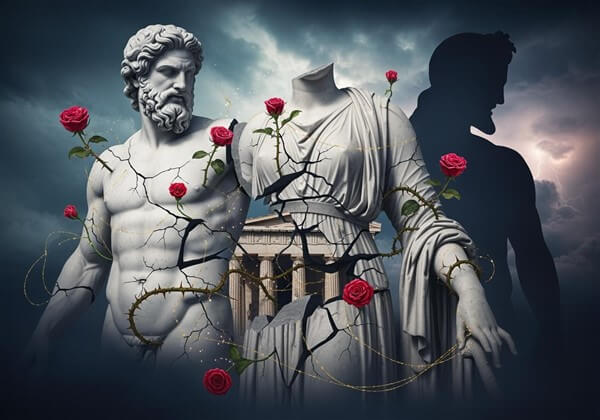
When we imagine the gods of Mount Olympus, we often picture serene, marble-skinned figures draped in white togas, presiding over the mortal world with detached majesty. Yet, the stories passed down from ancient Greece paint a far more dramatic and relatable picture. The Olympian gods were anything but placid; they were beings of immense power, driven by passions as fiery and unpredictable as any human’s. Love, jealousy, ambition, and betrayal were the currencies of their realm, leading to conflicts that shaped destinies and epic tales that have fascinated humanity for millennia. These deities were not just symbols of natural forces but characters in a grand, ongoing drama, their hearts entangled in webs of desire and rivalry.
This exploration delves into the intricate and often scandalous world of the Olympian gods’ relationships. We will move beyond the surface-level tales to examine the complex emotional currents that flowed between them. From the tempestuous marriage of the king and queen of the gods to the bitter rivalries that built cities and the personal grudges that fueled wars, these stories offer more than just entertainment. They are a profound reflection of ancient Greek society, its values, and its understanding of the human condition. By examining these divine dramas, we can gain insight into how the Greeks viewed love, power, and the chaotic, beautiful, and often painful nature of relationships.
The Archetype of Marital Strife: Zeus and Hera’s Eternal Power Struggle
The King’s Infidelity and the Queen’s Wrath
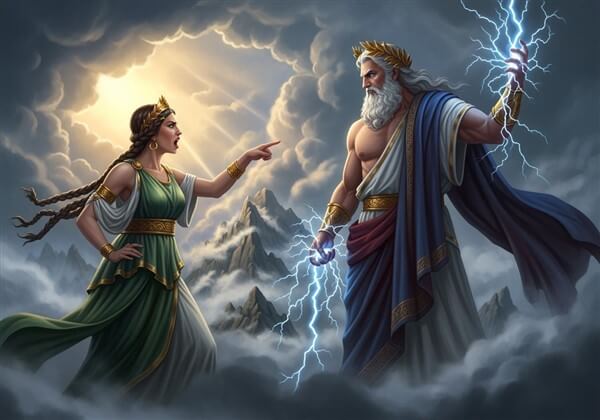
At the pinnacle of the Greek pantheon sits its most iconic and dysfunctional couple: Zeus, the mighty king of the gods, and his sister-wife, Hera, the formidable queen. Their marriage is a cornerstone of Greek mythology, but it is far from a romantic ideal. Instead, it is a perpetual battlefield of infidelity and retribution. Zeus, whose domain includes the sky and thunder, is also a figure of insatiable lust, constantly pursuing goddesses, nymphs, and mortal women. His affairs are not merely personal failings; they are assertions of his supreme power, scattering his divine offspring across the mortal world and reinforcing his dominion.

Hera, the goddess of marriage, women, and childbirth, is often depicted as a shrewish, jealous wife. However, this is a gross oversimplification of her character. As queen of the gods, her fury is not just personal jealousy but a response to the constant undermining of her authority and the sanctity of the institution she represents. Each of Zeus’s affairs is a direct insult to her status and a threat to the stability of the divine order. Her vengeance, though often cruel and directed at the innocent, is a desperate attempt to assert her power and protect her domain. The dynamic of the Olympian gods’ relationships is perfectly encapsulated in their endless cycle of transgression and retaliation, a celestial drama that reveals deep-seated anxieties about power, fidelity, and gender roles in the ancient world.
Io’s Ordeal: A Mortal Caught in a Divine Crossfire
Among the countless victims of Zeus and Hera’s marital discord, the story of the priestess Io is one of the most tragic. A beautiful mortal woman, Io caught the eye of Zeus, who seduced her under the cover of a thick cloud to hide his actions from his ever-watchful wife. But Hera was not so easily deceived. To protect Io, Zeus transformed her into a beautiful white heifer. Hera, seeing through the ruse, cunningly asked for the heifer as a gift, a request Zeus could not refuse without revealing his guilt. Once Io was in her possession, Hera’s revenge began. She assigned the hundred-eyed giant, Argus Panoptes, to watch over the heifer, ensuring she could never be alone.
Even after Zeus sent the messenger god Hermes to slay Argus, Io’s suffering was far from over. Enraged, Hera sent a relentless gadfly to sting the poor heifer, driving her into a frenzy of madness and pain. Io was forced to wander the known world, tormented and without rest, crossing from Europe into Asia. Her journey was a harrowing ordeal, a stark illustration of the collateral damage inflicted by the gods’ conflicts. Mortals in these myths are often little more than pawns in the grand game of divine politics, their lives irrevocably altered by a passing fancy or a fit of godly rage. Io’s story is a powerful testament to the powerlessness of humanity in the face of the gods’ whims and a somber reflection on the suffering of the innocent caught in the crossfire of the powerful.
When Rivalry Builds a City: Athena and Poseidon’s Contest for Athens
A Clash of Wisdom and a Force of Nature
Not all divine conflicts were born of romantic betrayal. Some of the most significant rivalries among the Olympians stemmed from ambition and the desire for influence over the mortal world. The contest between Athena and Poseidon for the patronage of a new, unnamed city in Attica is a prime example. This was not just a squabble between deities; it was a clash of fundamental principles and worldviews. Poseidon, the tempestuous god of the seas, earthquakes, and horses, represented the raw, untamable power of nature. He was a force of chaos and immense strength, a god whose favor could bring maritime dominance but whose wrath could shatter coastlines.
In stark contrast stood Athena, the goddess of wisdom, strategic warfare, craftsmanship, and civilization. Born fully formed from the head of Zeus, she embodied intellect, foresight, and the arts of peace and prosperity. The rivalry between these two powerful deities was a symbolic struggle for the soul of the future city. Would it be a society defined by brute force and naval might, or one built on wisdom, law, and sustainable prosperity? Their competition for what would become Athens highlights the diversity within the Olympian gods’ relationships, showing that their interactions were as much about philosophical differences and political ambition as they were about personal passions.
The Olive Tree Versus the Saltwater Spring
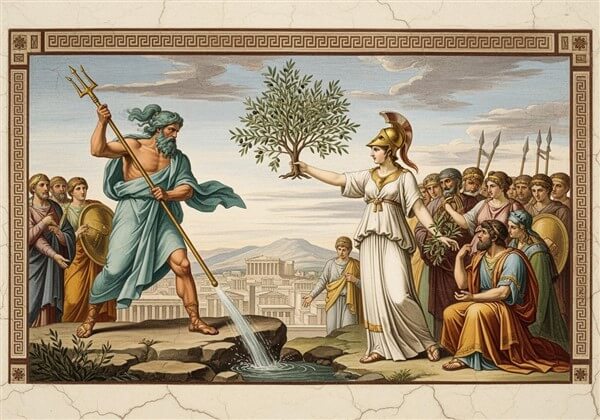
The contest to win the city’s devotion was to be decided by a single gift. Gathering on the rocky hill of the Acropolis, the two gods presented their offerings before the city’s inhabitants and their king, Cecrops. Poseidon, with dramatic flair, struck the ground with his mighty trident, and a spring of water gushed forth. It was a powerful display, symbolizing his command over the waters and promising the city naval supremacy. However, the gift had a critical flaw: the water was salty, like the sea he ruled, and thus undrinkable and of little use for agriculture.
Athena’s gift was far less dramatic but infinitely more profound. She quietly knelt and planted a seed, which instantly grew into the world’s first olive tree. She explained that this tree would provide food, oil for cooking and lamps, and wood for building. The olive tree was a symbol of peace, sustenance, and long-term prosperity. The choice for the Athenians was clear. They valued the practical, life-sustaining gift of wisdom over the showy, impractical display of brute force. They chose Athena as their patron, and the city was named Athens in her honor. This foundational myth is a powerful commentary on the values the ancient Athenians held dear, prioritizing civilization, peace, and intellectual strength over the wild, unpredictable power embodied by Poseidon.
The Divine Factions of the Trojan War

Picking Sides: Personal Grudges and Ancient Alliances
The Trojan War, the most legendary conflict of Greek mythology, was not fought by mortals alone. The ten-year siege of Troy was as much a war among the gods as it was among men, with the battles on the plains of Ilium mirrored by squabbles on Mount Olympus. The gods’ intervention was not random; they chose their sides based on a web of personal allegiances, ancient grudges, and wounded pride. The seeds of this divine conflict were sown at the wedding of Peleus and Thetis, where the goddess of discord, Eris, threw a golden apple inscribed “For the Fairest.” The ensuing dispute between Hera, Athena, and Aphrodite was settled by the Trojan prince Paris, who awarded the apple to Aphrodite in exchange for the love of the world’s most beautiful woman, Helen of Sparta.
This “Judgment of Paris” created an irreparable rift. Aphrodite, naturally, sided with the Trojans, protecting her chosen champion, Paris. Spurned and insulted, Hera and Athena became implacable enemies of Troy and staunch allies of the Achaeans (Greeks). Poseidon also sided with the Greeks, nursing an old grudge against the Trojan king Laomedon, who had refused to pay him for building the city’s walls. On the Trojan side, Apollo favored Hector and the city of Troy, while his twin sister Artemis and the god of war, Ares (Aphrodite’s lover), also lent their support. Zeus, the king of the gods, attempted to remain neutral but was constantly manipulated by the opposing factions, his sympathies often leaning towards the Trojans, yet bound by fate to allow their downfall. The Olympian gods’ relationships directly dictated the course of the war, turning a mortal conflict into a cosmic proxy battle.
Battlefield Interventions and Celestial Squabbles
The gods’ involvement in the Trojan War was direct and often brutal. They did not simply watch from afar but walked the battlefield in disguise, deflecting spears, inspiring courage, and striking down heroes. Their interventions highlight the intimate and often manipulative relationship between gods and mortals. Athena, a fierce supporter of the Greeks, famously guided the spear of the hero Diomedes, allowing him to wound not one, but two gods: Aphrodite and Ares. The sight of the goddess of love and the god of war fleeing the battlefield, wounded by a mortal, demonstrates the chaotic and personal nature of the divine involvement.
On Mount Olympus, the conflict was just as intense. The gods argued, schemed, and even came to blows, their celestial disputes directly impacting the fighting below. Hera would frequently use her charms to seduce and distract Zeus, allowing the Greeks to gain an advantage while he was otherwise occupied. Poseidon defied Zeus’s direct orders to stay out of the fight, rallying the Greek troops at a critical moment. These stories show that the gods were not omnipotent, dispassionate beings but were bound by their own emotions, rivalries, and relationships. The fate of the great city of Troy and its heroes was ultimately a consequence of these divine feuds, a testament to how the Olympian gods’ relationships could raise and ruin the fortunes of humankind.
The Enduring Mirror of Olympus
The tales of the Olympian gods are far more than quaint stories from a bygone era. As we’ve seen through the marital strife of Zeus and Hera, the professional rivalry of Athena and Poseidon, and the factional chaos of the Trojan War, these myths are sophisticated and timeless explorations of the very essence of relationships. They tackle themes of love and infidelity, ambition and jealousy, loyalty and betrayal with a raw honesty that still resonates today. The gods, in all their flawed glory, act as a divine mirror, reflecting the most profound and often troubling aspects of human nature. Their passions, though grander in scale, are fundamentally our passions. Their struggles for power and recognition are our struggles.
These narratives reveal a worldview where relationships are complex, messy, and fraught with consequences. They show that even for the most powerful beings imaginable, love is not simple, and power does not grant immunity from heartache or conflict. The Olympian gods’ relationships serve as a vast mythological canvas upon which the ancient Greeks painted their understanding of the human heart. They remind us that our own lives are shaped by the same intricate dance of emotion, ambition, and connection. Which of these divine dramas do you find most compelling, and what do you think these ancient stories tell us about our own modern relationships? Share your thoughts in the comments below.
Further Readings
Burkert, W. (1985). Greek Religion. Harvard University Press.
Dowden, K. (1992). The Uses of Greek Mythology. Routledge.
Fry, S. (2018). Mythos: The Greek Myths Retold. Penguin Books.
Graves, R. (2017). The Greek Myths: The Complete and Definitive Edition. Penguin Books.
Hamilton, E. (2017). Mythology: Timeless Tales of Gods and Heroes. Black Dog & Leventhal.
Hard, R. (2004). The Routledge Handbook of Greek Mythology. Routledge.
Kerenyi, C. (1951). The Gods of the Greeks. Thames & Hudson.
Powell, B. B. (2015). Classical Myth. Pearson.
Veyne, P. (1988). Did the Greeks Believe in Their Myths?: An Essay on the Constitutive Imagination. University of Chicago Press.
Woodford, S. (1993). The Trojan War in Ancient Art. Cornell University Press.