
 Home
Home ByKus Academy
 History
 Philosophy
 Anthropology
 Mythology
 Theology
 News
News World
World Economy & Finance
 Health & Lifestyle
 Science & Tech
 Culture
 Cinemania
 Bookshelf
 Who is?
 What is?
 Art
Art Türkçe

Introduction
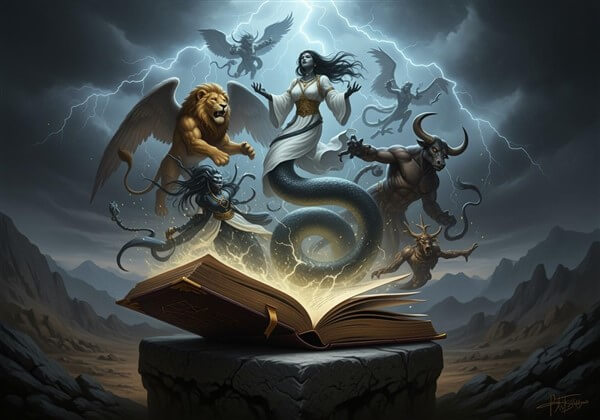
Greek mythology captivates us with its incredible creatures. Each one embodies unique symbols and lessons that still resonate today. These beings, from the Minotaur to Medusa, are not just fantasy. They are deeply woven into Greek cultural and philosophical thought. They served as metaphors for human fears, societal challenges, and natural phenomena. This gave the Greeks a way to explore complex ideas within a mythic framework. These creatures often represented the line between the known and the unknown. They reflected Greek attempts to understand their world.

Furthermore, the meaning of these monsters goes beyond simple stories. They reveal ancient Greek views on morality and the human condition. For instance, the Minotaur symbolizes the dangers of unchecked power. Similarly, Medusa’s transformation from beauty to beast explores themes of justice and vengeance. By exploring the symbolism of mythological creatures, we uncover layers of meaning. These layers shed light on how the ancients interpreted both their world and human nature itself.
Creatures of Transformation and Hybridization
The Minotaur: Man, Bull, and the Labyrinth
The Minotaur is one of mythology’s most intriguing creatures. It was born from both human deceit and divine will. According to myth, the creature was the offspring of Pasiphae, wife of King Minos, and a magnificent bull. Poseidon had sent the bull as a test of loyalty. King Minos failed to sacrifice it, leading to the birth of this hybrid monster. King Minos then confined the Minotaur to the Labyrinth. The architect Daedalus designed this elaborate maze. This setting highlights themes of entrapment and divine-mortal conflict.
The Minotaur’s hybrid form carries significant symbolic weight. Its bull head represents animalistic instincts, while its human body suggests intelligence. This portrays the dual nature of humanity—both civilized and savage. The Labyrinth itself symbolizes a complex journey. It reflects the inner struggles and moral choices we all must navigate. Therefore, the Minotaur within it serves as a powerful metaphor for the internal monsters one must conquer.
Centaurs: The Wild and Untamed Nature of Man
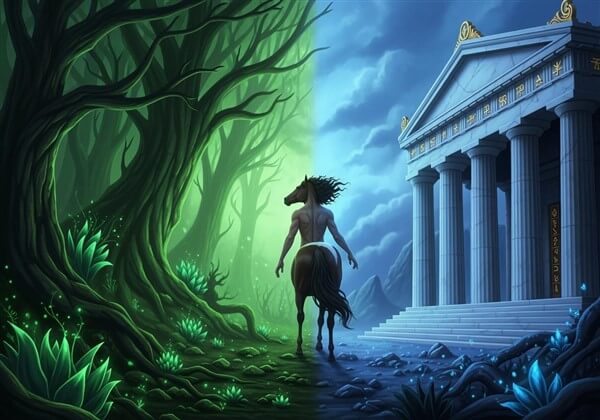
Centaurs, with the upper body of a man and the lower body of a horse, symbolize wild and primal forces. In myths, they often defy the civilized codes of Greek society. Their most famous myth tells of a wedding. There, they tried to abduct the bride, leading to a great battle known as the Centauromachy. This portrayal reflects Greek views on base instincts and the struggle between civility and savagery.
However, centaurs are not merely chaotic beings. They also embody the tension between our cultured and untamed sides. Their dual form is a metaphor for the human condition, caught between reason and impulse. The centaur Chiron complicates this image. He was known for his wisdom and healing knowledge, unlike his brethren. This suggests that integrating these dual aspects is both possible and desirable. This duality in the symbolism of mythological creatures like centaurs offers deep insight into Greek psychology.
Monsters of Fear and Danger
Medusa: The Petrifying Gaze and the Power of Perception
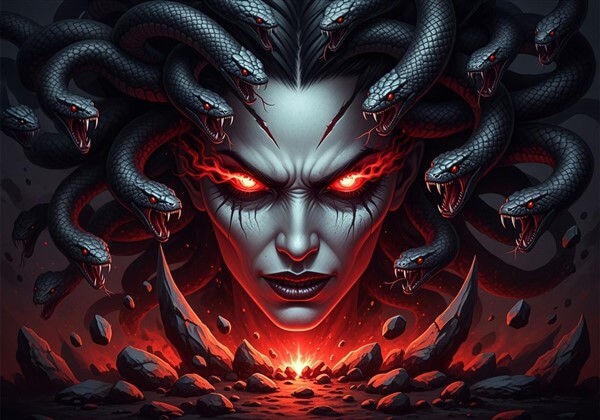
Medusa is one of mythology’s most terrifying figures. She was one of three Gorgons and the only mortal one. Her legend tells of a beautiful maiden who Athena punished. The goddess transformed her into a monster with snakes for hair. Her gaze turned any onlooker to stone. This story is rich with themes of violation, punishment, and victimization. It resonates with Greek views on divine justice.
The symbolism behind Medusa’s deadly gaze is multifaceted. Her ability to petrify with a look can represent the paralyzing effect of fear. It can also symbolize female rage or the consequence of facing harsh truths. Medusa’s monstrous form may also embody the fear of the unknown. It shows how ancient Greeks explored concepts of purity and danger. Her narrative cautions against moral transgressions. It also invites reflection on power, perception, and vulnerability.
The Hydra: Perseverance and the Cyclical Nature of Challenges
The Hydra was a formidable creature from the swamps of Lerna. It was known for its many heads, with one being immortal. Facing the Hydra was one of Hercules’s twelve labors. The challenge was daunting. The Hydra could regrow two heads for each one Hercules severed. This relentless ability has made the Hydra a symbol of resilience and seemingly insurmountable challenges. Hercules’s eventual victory, which involved cauterizing the necks, highlights themes of innovation and strategy.
Symbolically, the Hydra represents the persistence and cyclical nature of problems. Each head can be seen as a new obstacle emerging from an attempt to solve a previous one. This is a metaphor for the complex nature of human struggles. The myth encourages us to think about how we approach persistent difficulties. It emphasizes that traditional methods are sometimes not enough. The symbolism of mythological creatures like the Hydra explores endurance and the need for new tactics, ideas that remain relevant today.
Guardians and Protectors: Mythical Creatures as Embodiments of Nature’s Power

The Sphinx: Riddles, Wisdom, and the Consequences of Ignorance
The Sphinx is an enigmatic creature with a lion’s body and a human’s head. It is best known for its role in the myth of Oedipus. The Sphinx posed a fatal riddle to all travelers. It only spared those who could answer correctly. This portrayal shows the Sphinx as more than a physical guardian. It was a gatekeeper to knowledge. In the story, the riddle serves as a metaphor for life’s intellectual and moral challenges. Oedipus’s triumph represents human wit overcoming divine puzzles.
The symbolism of the Sphinx extends to broader themes of wisdom and the perils of ignorance. Its riddles represent the mysteries of life that humans strive to understand. The fatal consequence of failure shows the serious repercussions of ignorance. The Sphinx’s role as a protector of sacred knowledge reinforces an important idea. It shows that wisdom is not easily won. It must be pursued with courage and intellect. Thus, the Sphinx is a powerful allegory for the quest for understanding.
The Griffin: Guardians of Treasures and the Duality of Nature
The Griffin is a majestic creature with the body of a lion and the head and wings of an eagle. It is a symbol of strength and vigilance. Myths from Greek to Persian cultures depict Griffins as guardians of treasures. They often protected gold and precious gems. This role highlights the Griffin’s dual nature. It combines the terrestrial might of a lion with the aerial prowess of an eagle. This symbolizes mastery over both earth and sky. Its noble bearing made it an emblematic protector.
Symbolically, the Griffin also represents the duality of nature’s power. By combining the king of beasts and the king of birds, Griffins symbolize a union of opposites. This reflects the complex interplay of forces in the natural world. This duality can be seen as a metaphor for the balance required in managing power. As guardians, Griffins underscore the themes of protection and the challenges faced by those who defy natural or divine barriers. The symbolism of mythological creatures is rich with these lessons.
Conclusion
Mythological creatures in ancient Greece were not just products of imagination. They were pivotal elements that reflected and shaped the culture. These beings, from the wise Sphinx to the mighty Griffin, embodied various human and natural traits. The Greeks used these creatures to explore themes of wisdom, power, and protection. These stories served educational purposes, offering insights into human psychology and societal norms. The creatures symbolized the fears, hopes, and dreams of the Greeks, acting as mirrors to their world.
The enduring relevance of these symbols is evident even today. The symbolism of mythological creatures continues to capture our imagination in literature, film, and art. They serve as powerful metaphors for the human condition. They remind us of our quest for knowledge and the dangers of ignorance. Through these ancient symbols, we explore our deepest fears and the moral fabric that holds societies together. In essence, these creatures teach us about resilience, caution, and balance—lessons that remain profoundly relevant.
Further Readings
Bulfinch, T. (1855). Bulfinch’s Mythology. Harper & Brothers.
Buxton, R. (2004). The Complete World of Greek Mythology. Thames & Hudson.
Cline, E.H. (2013). 1177 B.C.: The Year Civilization Collapsed. Princeton University Press.
Demand, N. (1994). Birth, Death, and Motherhood in Classical Greece. Johns Hopkins University Press.
Dodds, E.R. (1951). The Greeks and the Irrational. University of California Press.
Garland, R. (1992). The Greek Way of Life: From Conception to Old Age. Cornell University Press.
Graves, R. (1955). The Greek Myths. Penguin Books.
Green, M. (1992). Animals in Celtic Life and Myth. Routledge.
Hamilton, E. (1942). Mythology: Timeless Tales of Gods and Heroes. Little, Brown and Co.
Kerenyi, C. (1951). The Gods of the Greeks. Thames & Hudson.
Kerenyi, C. (1959). The Heroes of the Greeks. Thames & Hudson.
Kerenyi, C. (1976). Dionysos: Archetypal Image of Indestructible Life. Princeton University Press.
Kirk, G. S. (1974). The Nature of Greek Myths. Penguin Books.
Mayor, A. (2000). The First Fossil Hunters: Dinosaurs, Mammoths, and Myth in Greek and Roman Times. Princeton University Press.
Ogden, D. (2013). Dragons, Serpents, and Slayers in the Classical and Early Christian Worlds: A Sourcebook. Oxford University Press.
Peck, H. T. (1898). Harpers Dictionary of Classical Literature and Antiquities. Harper & Brothers.
Pemberton, E. (1987). The Presence of the Past: Morphic Resonance and the Habits of Nature. Times Books.
Pinch, G. (2002). Handbook of Egyptian Mythology. ABC-CLIO.
Pluskowski, A. (2004). Wolves and the Wilderness in the Middle Ages. Boydell Press.
Simpson, M. (1989). Gods and Heroes of the Greeks: The Library of Apollodorus. University of Massachusetts Press.
Stafford, E. (2012). The Routledge Companion to the Study of Local Religion and Local Culture. Routledge.
Stafford, E. (2012). The Routledge Companion to Mythology. Routledge.
Wilkinson, T. (2003). The Complete Gods and Goddesses of Ancient Egypt. Thames & Hudson.